Bitcoin & Altcoins: August Market Catalysts & News
Discover key Bitcoin and altcoin catalysts this week in August 2026. From Fed policy to regulatory updates, learn what's driving crypto market movements.
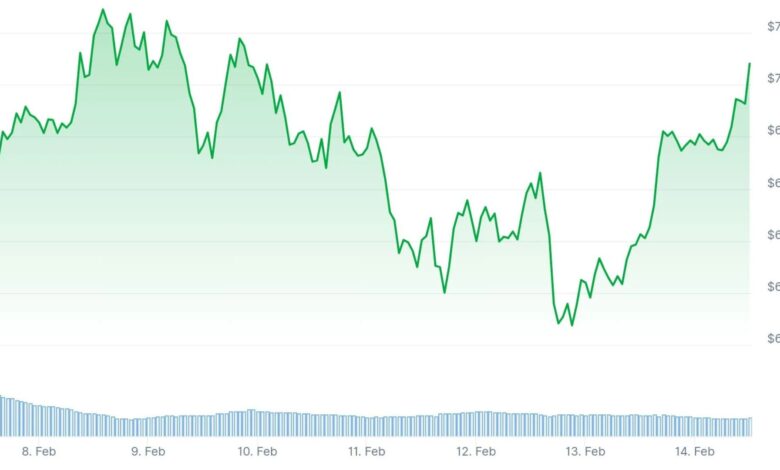
The crypto market this week stands at a critical juncture as Bitcoin hovers near $63,000–$64,000, facing significant technical resistance and waiting for major macroeconomic catalysts to determine its direction. The cryptocurrency news cycle this August brings multiple market-moving events that could reshape price action for Bitcoin and the broader altcoins sector. Understanding these catalysts is essential for anyone tracking crypto price trends and seeking to navigate the market’s current consolidation phase.
Current State of Bitcoin and the Broader Crypto Market
Bitcoin price movements have been defined by compression and indecision throughout July and early August 2026. The leading cryptocurrency trades in a defined range between $60,000 support and $68,500 resistance, with every major technical level contested by institutional traders managing enormous derivatives positions. This Bitcoin trading pattern reflects a market where retail enthusiasm has faded, ETF flows have turned negative after months of volatility, and futures liquidations remain a constant threat to price stability.
Altcoin market conditions mirror Bitcoin’s struggles, with most major tokens down 32–44 percent year-to-date. cryptoticker.io Rather than moving in unison as they once did, altcoins now trade on token-specific catalysts, creating what market analysts describe as a correlation breakdown—a phenomenon that separates winners from losers based on fundamental developments rather than broad crypto market sentiment. Cryptoticker.io This shift toward fundamentals-driven trading marks a maturation in how institutional capital allocates across the digital assets space.
The Federal Reserve Decision: The Week’s Biggest Catalyst
How the Fed’s Rate Hold Shapes Bitcoin’s Near-Term Outlook
The Federal Reserve’s decision to hold interest rates steady at 3.50%–3.75% on July 29, 2026, removed one major source of downside risk but failed to ignite broader market optimism. However, the decision carried significant nuance that will reverberate throughout August: three Fed members voted for a rate hike, marking the sharpest committee split since September 2016. This dissent signals that policymakers view inflation as a persistent threat, which directly constrains Bitcoin’s bullish case and keeps real yields elevated enough to suppress appetite for long-duration risk assets like cryptocurrencies.
Bitcoin’s relationship to Fed policy is counterintuitive to many observers. Despite Bitcoin’s independence from traditional banking systems, its price is deeply connected to moves in capital markets. When the Federal Reserve raises interest rates, the opportunity cost of holding a non-yielding asset like Bitcoin increases, as safer treasury securities offer higher returns. Conversely, when the Fed signals dovish monetary policy, investors rotate toward riskier assets, including crypto holdings. The current environment—neither hiking nor cutting—leaves Bitcoin trapped in a holding pattern where macroeconomic uncertainty trumps all other factors.
Key Economic Data Releases Expected in August
The real test of Bitcoin’s directional bias arrives through August’s economic calendar, which will reveal whether the U.S. economy is cooling enough to justify rate cuts or whether inflation remains too stubborn for the Fed to pivot. Several tier-one economic releases are scheduled to move markets:
- Employment Situation (August 7): This report represents the first major test of the Fed’s outlook after the July meeting. A softer-than-expected payroll number could reignite talk of near-term rate reductions, which would be bullish for Bitcoin. Conversely, strong hiring data would reinforce the hawkish narrative and weigh on crypto prices.
- CPI and PPI (August 12–13): Inflation data takes center stage as markets parse whether goods prices and services inflation are trending toward the Fed’s 2 percent target. These figures are considered the most important Bitcoin catalysts this month because they directly inform Fed expectations and real yield assumptions.
- Jackson Hole Symposium (August 27–29): This annual central banking conference will host speeches from Federal Reserve officials and international policymakers. Any hints about the Fed’s September rate decision or broader monetary policy outlook will likely trigger sharp Bitcoin and altcoin moves.
The crypto market’s reaction to these events depends less on the data themselves and more on how traders interpret the Fed’s reaction function—whether the central bank will cut, hold, or hike based on incoming information.
Bitcoin’s Technical Standoff: Resistance, Support, and Price Targets
Major Technical Levels Bitcoin Must Navigate
Bitcoin’s price action is currently defined by a descending trendline that has rejected every rally attempt since July 21, when BTC peaked near $66,803. Below this trendline sits the 200-period EMA at $63,969, which recently flipped from support to resistance—a technically bearish signal for bulls trying to sustain a recovery. Horizontal resistance sits at $65,000, a psychologically significant level that Bitcoin lost in late July.
On the downside, Bitcoin’s support structure is layered but concerning. The primary $62,000 support zone has been tested twice in recent weeks and held, but if bears decisively break below this level, the next major floor sits at $58,000, marking roughly an 8 percent decline from current levels. Most analysts agree that a close below $59,500–$60,000 would trigger accelerated selling toward $55,000–$53,000 in a death cross scenario that has historically preceded 30 percent corrections.
What Bitcoin Experts Predict for August
AI price prediction models offer competing scenarios that illustrate the market’s genuine uncertainty. ChatGPT predicts Bitcoin will finish August near $60,500, with a 55 percent probability of closing between $58,000 and $64,000—essentially a sideways, choppy consolidation. The model assigned a 25 percent probability to a bearish scenario sinking toward $50,000–$57,000, and only a 20 percent chance of a bullish breakout toward $68,000–$75,000.
In contrast, other AI models like Gemini and Claude are more constructive, identifying the $65,000–$70,000 resistance zone as critical territory Bitcoin must reclaim to reverse its medium-term downtrend. Yahoo One of the most bullish assessments came from Grok, which flagged several algorithmic forecasts clustering between $65,000 and $80,000, with CoinCodex projecting $66,800–$74,200 and Changelly suggesting $68,400–$74,000. Yahoo However, even bullish models emphasize that macroeconomic developments, institutional flows, regulation, or unexpected events could easily invalidate these targets.
Altcoin Market: Where Institutional Capital Is Flowing
Ethereum: The Backbone of Institutional Tokenization
Ethereum continues to dominate institutional blockchain adoption, with major financial firms using ETH as the preferred settlement layer for tokenized securities and treasury products. 6Unlike Bitcoin, which serves primarily as a store of value, Ethereum’s utility as decentralized finance (DeFi) infrastructure and stablecoin settlement system creates genuine demand drivers that transcend crypto sentiment cycles.
BlackRock’s recent launch of tokenized money market funds on both Ethereum and Solana demonstrates how institutional capital is increasingly viewing layer-one blockchains as critical infrastructure for the future of finance. This development is particularly bullish for Ethereum, as it cements ETH’s role as the backbone of real-world asset tokenization, the fastest-growing crypto use case in 2026.
Emerging Altcoin Catalysts: XRP, Solana, and Tokenization Leaders
XRP holders can now borrow RLUSD on Ethereum through a $280 million lending pool, marking a significant expansion of Ripple’s ecosystem beyond payment networks into DeFi infrastructure. coindesk.com This development signals that XRP is positioning itself within a broader financial ecosystem that includes tokenized assets and enterprise blockchain services, rather than relying solely on payment volumes. This strategic pivot could attract institutional capital seeking exposure to enterprise settlement use cases.
Solana (SOL) has benefited from its low transaction costs and high throughput, which make it an attractive blockchain for tokenized real-world assets (RWAs). A Solana proposal (SGP-0003) aims to ramp up daily SOL burns from $47,000 to $650,000, bundled with a fee overhaul and disinflation rate doubling. If this proposal gains validator support, it could meaningfully improve Solana’s long-term tokenomics and support SOL price appreciation.
Ondo Finance (ONDO) has emerged as the leader in tokenized equities, controlling more than 70 percent of the tokenized equities market with total value locked exceeding $4 billion. Recent milestones include launching an SEC-supported tokenization model alongside BlackRock’s IVV ETF, which validates institutional-grade tokenization infrastructure. Ondo’s governance proposal to permanently burn 100 million ONDO tokens strengthens its long-term tokenomics and demonstrates management’s commitment to token holder value.
Hyperliquid (HYPE), the decentralized perpetual futures exchange, represents the revenue model revolution in crypto. The protocol recently surpassed $1 billion in cumulative revenue, with 99 percent of trading fees funding open-market HYPE buybacks. Unlike many recently launched tokens, HYPE continues outperforming dramatically, with a 1,519 percent gain since its November 2024 token generation event—making it one of the rare altcoins that escaped the 2026 bear market.
Regulatory Catalysts: The Clarity Act and Its Implications for Altcoins
Congressional Push for the Clarity Act Before August Recess
The Clarity Act, cryptocurrency regulation legislation that would provide a regulatory framework for digital assets, faces a make-or-break moment before Congress’ monthlong August recess. This bipartisan bill is the centerpiece of the crypto industry’s legislative aspirations, and industry experts widely agree that passing crypto legislation this year requires finishing the bill before the August break. If the Clarity Act fails to advance before lawmakers leave town, the calendar becomes the enemy, with little room for another push before the midterm elections, which could shift congressional control and send the legislation back to the starting line.
However, significant hurdles remain that could prevent passage. Ethics provisions loom as the largest obstacle, with Democrats pushing for limits on how elected officials—most notably the president—can be involved in the crypto industry. Trump’s financial disclosures, revealing approximately $1.2 billion in crypto-related income, have “heightened concerns” among Senate Democrats that the president is pushing Congress to pass crypto legislation in favor of the industry he’s financially invested in.
Why Regulatory Clarity Matters for Altcoin Prices
The crypto market’s reaction to regulatory developments is immediate and severe. Bernstein strategists noted that failure to pass the Clarity Act this year would likely send crypto prices lower, but they expect U.S. regulators to accelerate rulemaking regardless. Meanwhile, Robinhood’s UK crypto registration before new regulatory regime kicked off demonstrates that jurisdictions worldwide are moving toward standardized regulation, which reduces uncertainty for institutional participants and supports longer-term cryptocurrency adoption.
The SEC’s Draft Strategic Plan for FY 2026–2030 designates digital assets as the agency’s first regulatory objective, committing to “provide a firm regulatory foundation for digital assets and distributed ledger technologies through a rational, coherent, and principled approach.” Equally important, the SEC and CFTC’s Memorandum of Understanding commits both agencies to reduce duplicative oversight and provide minimum effective regulation that fosters innovation while maintaining market integrity. This coordinated regulatory approach should eventually support altcoin valuations by removing regulatory uncertainty.
The Coldcard Exploit and Cold Storage Security Concerns
What the Wallet Hack Means for Crypto Security Sentiment
A major wallet exploit affecting Coldcard hardware wallets has drained approximately $114 million in cryptocurrency, affecting approximately 4,500 addresses. While Bitcoin price declined only modestly—roughly 2 percent—the loss of confidence in cold storage solutions has created what some analysts describe as erosion of investor trust in the most secure custody methods. Solo miners, however, benefited from the opportunity, with one individual netting a $200,000 BTC reward from the disruption in mining dynamics.
This event serves as a reminder that crypto security remains an ongoing concern, despite years of infrastructure maturation. Institutional investors managing billions in digital assets are likely to increase due diligence on hardware wallet manufacturers and custody solutions, potentially favoring established players with proven track records and insurance coverage.
Institutional Flows and Market Microstructure
Why ETF Flows Matter More Than Headlines
Spot Bitcoin ETFs saw net inflows of $172.4 million in July, ending two months of outflows but remaining nowhere near the pace that drove previous advances. ARP Digital’s Yusuf Fakhro noted that Bitcoin’s weakness reflects “stalled participation more than forced selling,” with CME open interest back at 2023 levels and Strategy remaining idle for a fifth straight week.
This market microstructure reveals the core challenge facing Bitcoin bulls: there is no institutional buying strong enough to overcome technical resistance and overhead supply. The Coinbase Premium Index has printed negative every session since May 19, marking a record run of more than 70 consecutive trading days as of late July. When premium indices turn negative, it signals that Bitcoin buyers on the spot market are disappearing, and arbitrageurs are instead selling Bitcoin futures to lock in spreads—a technologically sophisticated way of saying the market has shifted from buying pressure to distribution.
What This Means for Bitcoin and Altcoin Investors
The Consolidation Phase and Emerging Opportunities
The crypto market in August 2026 is not one where broad-based altcoin rallies are likely to sustain. Instead, institutional flows are concentrating around projects with real revenue, tokenization infrastructure, AI, decentralized trading, enterprise adoption, and payment networks. This shift favors Ethereum, Solana, XRP, Ondo Finance, and Hyperliquid—tokens with genuine utility catalysts—over purely speculative altcoins.
Consolidation phases are where institutional positioning happens. Prices stop trending, volume thins out, retail attention drifts elsewhere, and the assets that will lead the next expansion quietly change hands. For crypto investors, August represents a period of patience, where fundamental analysis trumps technical analysis and where conviction in long-term thesis matters more than short-term price movements.
Key Decisions Ahead for Traders
Bitcoin traders should monitor the $60,000–$62,000 support zone closely. A decisive breach below $60,000 would confirm the death cross scenario and potentially trigger a cascade of liquidations toward $53,000–$58,000. Conversely, a close above $68,500 with strong volume would signal that bulls are retaking control and could put $84,000–$88,000 back in play as realistic medium-term targets.
Altcoin investors should prioritize projects with institutional adoption, sustainable revenue models, and real-world use cases over speculative narratives. The tokenization boom, stablecoin infrastructure, and AI blockchain integration represent the sectors with the highest probability of sustained capital inflows in Q3 and Q4 2026.
Conclusion
August 2026 represents a pivotal month for cryptocurrency markets, where multiple macro catalysts—Fed policy, employment data, inflation prints, and the Jackson Hole symposium—will determine whether Bitcoin can break above resistance or deteriorates toward lower support levels. Altcoins are increasingly trading on fundamentals rather than sentiment, rewarding projects with genuine institutional demand and protocol revenue. The Clarity Act’s potential passage or failure adds another layer of regulatory uncertainty that could move crypto prices sharply in either direction.
Consolidation is the message of this period. Bitcoin’s range between $60,000 and $68,500 is narrowing, and a resolution is coming within weeks. Investors should remain vigilant of economic data releases, maintain disciplined risk management, and avoid emotional decision-making during volatility spikes. For those tracking crypto market trends this week, the next two weeks will prove decisive.